November 1, 2009

Namaste Brother!

This tickled me and I thought I’d share it with you. Its nice to see a Christian brother find something helpful in the wisdom of the East for a change and to want to share the inner meanings of a common Sanskrit greeting with his flock. I hope it helps everyone who listens.

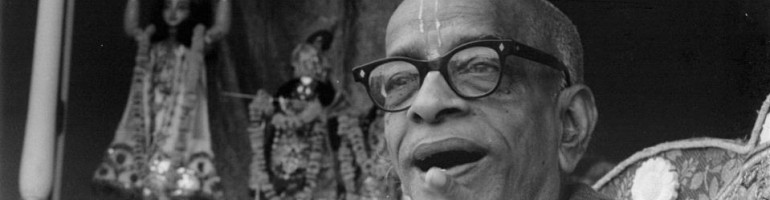
We should not be surprised when this happens. It will certainly happen more in the future. The wisdom of the Vedas is actually not the ‘wisdom of the east’ or ‘India,’ or the ‘Hindu religion’ but merely wisdom itself. As such, it is meant for all people, in all places, at all times, and in all languages. Its certainly too important to be kept in India, or locked away in the Sanskrit language. Luckily for us, Srila Prabhupada thought the same way and spent his time sharing it.

There’s no reason at all why the spiritual teachings of Lord Jesus Christ have to be permanently affiliated with Greek philosophy and the commentaries of Thomas Aquinas and his successors. Although that combination has served Europeans quite well over a number of centuries, more depth is required if Christianity itself is to survive the philosophical onslaughts it is currently undergoing. A carefully delineated siddhanta – a definitive statement of the existential nature of the soul, matter, time, space, God, illusion, moral law, and the relationships that exist between them – is required if Christianity is to perform its difficult task in the years ahead.

Combine the moral and devotional teaching  of Lord Jesus Christ with the foundational philosophy of the Vedas and you have something quite remarkable. Namaste, dear readers.

October 31, 2009

Australia 24-hour Sankirtan

After my grumbling yesterday about impending winter, I was at least happy to hear that my daughter Jahnavi is firmly situated in the Spring season. She is currently in Australia as a member of the kirtan group As Kindred Spirits. They are on a tour of different cities and today they are in Melbourne. In fact, its a special day for that city as the Vaishnava community there is conducting a 24-hour sankirtan.

If you are reading this on Saturday 31st October you can catch the kirtan on a livestream:
http://www.worldsankirtan.net:8000/kirtanradio.m3u

Jahnavi knows that I am missing her but that I’m happy she’s actively engaged in sankirtan. To make me feel better she sent a letter confirming that Srila Prabhupada wanted a ‘world sankirtan party’:

Letter to Hamsaduta from Srila Prabhuapda, dated January 22, 1968

Another proposal is I want to form a sankirtana party in which two
members will play mrdanga, eight will play the cymbals, two will play
on tampura, and one harmonium, besides that there will be the leader
of the party. This party will be so trained that exhibitions of our
chanting and dancing along with distribution of prasadam will be
performed on a stage and for this performance we will sell tickets to
the public. It will be known as a spiritual movement. Suppose if we
begin it from New York and there is good response from the public,
then our attempt will be successful prior to our traveling all over
the world. We will earn money by stage exhibitions and attract
attention of the elite public and move from one station to another. A
shorter type of this exhibition was held during our television show
and the performance was very much appreciated. So I want to train such a party immediately. I do not know where such training will take
place, but I want to do it immediately in my presence. So consult with
Brahmananda and others about this proposal. Give me your return
suggestions about this proposal.

October 30, 2009

Coming home from India to the cold, dark north

I came back from India yesterday. Oh dear. I watched the golden sun come up over a bleak and mountainous Afghanistan, chanting my gayatri mantra while peering out of a small window in the back of the plane. By breakfast time I was dipping down through the clouds into a grey, cold London.

Its not easy coming back from India. Over the past month, first in the middle of India, then in the south, the temperature has been around or just over 100F or 35C. I’ve come back to an England that is 64F or 17C. Its hard for my body to cope with the drastic change and now I’ve come down with a heavy cold and a cough. For the past month the sun has come up every morning at 5.45 and set every evening at 6.15. Now it’s not really light until 7.00 am and starts getting dark around 4.30!

During my last week in India, when I was living in Madras/Chennai, I was able to walk out of my door and purchase fresh jasmine, red and pink roses, and beautiful lotus flowers for just a few pence. And handfuls of tulasi leaves for even less. Today I looked in my garden and the very last of my marigolds were just barely hanging on.

And every morning, right outside my window, there was a musical, religious procession featuring a white horse, a black cow, chanting brahmanas, a nadeshwaram band, and a decorated chariot bearing the brightly garlanded temple image of a Vaishnava saint. This morning, right outside my house, there was the milkman.

I’m not complaining, of course. My Lord Shri Krishna lives equally in England and in India, and can always be found if I look for Him. Its just that its marginally easier for my mind to appreciate His presence when the sun is shining, ancient temple bells are ringing, and my neighbours all wear tilak.

Still, my raspberries are still growing – and you can’t get them in India. And the darkness can always be chased away by the lighting of candles and the burning of fires. No wonder the ancient Celtic people of these dark, northern lands devised celebrations like All Hallows Eve (Halloween) at the end of summer, when lanterns were lit and ghosts frightened away.

But, my dear readers, let us steel ourselves for the great darkness that will soon be upon us. Three months of cold and dark until the sun changes course on January 14th. Even though it is more difficult to chant the holy names of Krishna on the dark, cold mornings when you’d rather be in bed, still take heart and do it, for it will do you a power of good. By the chanting of the maha-mantra the sun of Krishna consciousness will rise over the landscape of your innermost heart and you will dwell permanently in the spiritual warmth of the eternal sunshine.

October 17, 2009

Through Nrsimhadeva’s jungle

I write this with the sound of Diwali firecrackers going off all over the town. I am in Tirupati, in the southern Indian state of Andhra Pradesh. Tomorrow is a big Diwali festival here at the ISKCON temple There will be the ceremonial burning of a 40-feet high image of the demon king Narakasura who was killed on this day by Lord Krishna and His wife Satyabhama. There will also be an hour-long firework show. About 10,000 people are expected.

The pastime of Bhaumasura – the demon with a thousand arms – was also connected to this period of the year. Local tradition has it (!) that one of the seven defensive walls of Bhaumasura was made of firecrackers so they recreate that too!

I came back from Ahovalam, the place of Lord Narasimha, last night. I had a good local guide. Quite a trek through real jungle up the hills with the booming sounds of huge monkeys and tropical birds. A bit disconcerting that there are bears and cheetahs in the jungle too. But it was very rewarding to take darshan of many of the nine forms of Narasimhadeva. Many of them are in caves where previously devotees and yogis used to meditate. Apart from the jungle sounds the place is very tranquil and it was very easy to think of God there.

Half way up one hill you have to walk over a bridge cut out of the cliff face. There is a waterfall crashing onto the path and a deep gorge below you. So you have to walk right through the waterfall. Scary. Thing is, you are so hot and sweaty by the time you get to that point that some cold mountain water is just what you need. Some of the Deities of Sri Narasimha are in places so inaccessible that they don’t receive daily worship any more. The local tribal Chenchu who live in the jungle come to wash the temple floors and draw rice flour patterns on the wet stone. They light up oil candles to illuminate the Deities. But it is the brahmanas who come to bathe the Deities and perform the ritualistic worship on a limited, regular basis. They all have the front part of their heads shaved and have huge U-shaped white tilak with a yellow line inside to represent the Goddess. This they wear on their foreheads and in 11 other positions on their chest, arms and neck according to the custom of their sampradaya. They were grateful to see that we’d taken the trouble – albeit puffing and wheezing – to come and see their Lords, and they responded by giving us garlands of tulasi leaves and red kumkum. As they waved the camphor flame in front of the Deity they would introduce us to the Deity and also point out His special features.

I saw a Muslim couple making the trek up the hill. She was dressed in the traditional black full veil. He looked a little sheepish that we’d noticed them. Apparently, Lord Narasimha is well known and worshipped around here by childless couples who don’t remain childless for much longer. Lord Nrsimha is very kind in a variety of ways.

October 3, 2009

Tis the night before Kartik

I’m in India and its the night before the beginning of Kartik month. This afternoon we had a monsoon downpour after a grey and muggy morning. Right now the full moon is hanging in the sky and the crickets have all come out to sing to it.

If I was at home in England we would cook up some sweet rice and place it out in the garden so that Lord Krishna and the gopis could eat it after dancing. It would always be gone by six the next morning, although my children had much more to do with that.

The lunar month of Kartik – also known as Damodara – is a month to further our bhakti. Devotion can grow like a precious plant if you water and feed it, and the activities of devotion, especially in the kartik month, are a further opportunity to do that.

Writing in the sixteenth vilas (chapter) of his Hari-Bhakti Vilas, the Vaishnava handbook of ritual, sacraments, worship and festivals, Srila Sanatana Goswami writes that there are five acts that confer special blessings during this month:

1. Taking a bath – not just your normal shower but bathing while you remember Lord Krishna, if you don’t normally do that.

2. Tulasi seva – serving the Tulasi plant in some way. That could include watering or even sowing a tulasi seed in your home. She makes herself easily available for you to do that and is known in Latin as occimum sanctum, available online from many specialist seed shops.

3. Lighting a lamp – lighting a candle before an image or picture of Krishna in this month is a very special act of devotion. Keeping it burning confers extra grace. Please take all safety precautions.

4. Giving in charity – to a deserving person or cause. The custom is that whatever luxury items you give up for Kartik you give the money saved at the end of the month. But there’s nothing to stop you giving any time during the month.

5. Staying awake all night – not an easy one, but one all-nighter or a vigil until the small hours while you chant, sing or read with friends will be a great contribution to your kartik observance.

But as always, everything you do for Krishna and His beloved Radharani will be accepted by them and fully reciprocated. Hare Krishna.

September 21, 2009

Diksha and Drugs: An Unfortunate Combination

Some years ago, when I heard the story of three young men celebrating their Vaishnava diksha with a round of cold Guinness, I thought it was the beginning of an Irish joke. Unfortunately it was true. The guru who’d given them their initiation had omitted to tell them anything at all about the practical disciplines of spiritual life and so they’d assumed that their old life could continue as normal.

Over the years many similar stories have reached me, all concerning the absence of customary instruction on the life of a Vaishnava, especially the parts about giving up intoxication.  There are many tales now of aspiring Vaishnavas, perhaps visiting India for the first time, being misled by a spiritual preceptor who allows them to continue with their drinking or smoking in the name of being ‘merciful’. But the combination of initiation and intoxication only produces confusion and, in the long term, sadness and depression.

And it doesn’t stop at a celebratory Guinness. Mother Nature produces a wide variety of substances that can be ingested by being licked, chewed, drunk, and sucked. Although she provides them for medicinal or other purposes, when misapplied or taken to excess they can result in powerful intoxication, inebriation, and hallucinogenic experiences. And when men take those gifts of nature and decide to refine, ferment, distil, then drink, smoke or inject the products, the result can be total addiction and complete destruction.

Its nothing new, of course. Alcohol has been a destructive part of life since the days of the Vedic sages, and both the poppy and the ganja plant have always grown wild in India. All these, and many more, have been used by certain classes of men since time immemorial. And since time immemorial they have been condemned by wise teachers who wanted to help them towards a greater, longer lasting happiness.

So when a candidate comes for initiation into spiritual life, they are expected to have already made a commitment to refrain from taking intoxicating substances. And the guru is expected to help them make that commitment and to then to uphold it through his good instruction.

The fact that some spiritual preceptors are not doing that is, sadly, nothing new. There have always been forgetful or neglectful gurus who omitted important teachings and inadvertently led their disciples astray; and there have been others that deliberately left out teachings on discipline in order to gather a popular following. But that disciplic descendants in the line of Srila Bhaktivinode Thakur and Srila Bhaktisiddhanta Thakur are now doing so is troubling. Both of those great acaryas, and then, in their line, Srila A.C.Bhaktivedanta Swami Prabhupada, strenuously taught about the dangers of intoxication and campaigned against the foolish combination of diksha and drugs.

So I was perturbed when, last year, I saw a young man with neckbeads and forehead tilak markings walking through the street of an English town with a half-finished can of cider. When I stoped him to ask his name it was obvious that he’d been drinking for some time. I was equally troubled when I saw another devotee smoking. But I was very saddened when another young man, newly initiated, recently collapsed of a drug overdose in one of our preaching centres.

Then, just two weeks ago, I was told the tragic story of a married man with a wife and child. He was initiated and looking forward to his upcoming trip to India when he would receive his gayatri diksha. Unfortunately, being insufficiently guided by his ‘most merciful’ preceptor, he’d continued his fascination with his drug of choice. But his favourite substance was an hallucinogenic, used by Amazonian shamans for visionary experiences. At a party he consumed too much, was taken to hospital, but later died.

Srila Prabhupada instituted the recitation of the ‘four regulative principles’ at every initiation ceremony. Before he gave a disciple their new Vaishnava name, he would ask them to declare vocally in public that from that moment forward they would consume no intoxicating substance, not even tea and coffee. His disciples followed his example and the declaration of the four principles is now a standard component of every such ceremony.

Yet apparently this is not done by others, even by those who praise Srila Prabhupada and everything he did, even to the point of declaring themselves to be ‘his siksha disciple.’ Why this should be, we don’t know. But it may – albeit inadvertently – give those who are coming so fresh to Vaishnava life the mistaken impression that one can chant the Hare Krishna mantra and simultaneously engage in consumption of intoxicants. Such an idea runs counter to everything taught by the previous acaryas; runs against the current of advice given the holy Srimad Bhagavatam; and is patently not producing the desired results.

If we are to prevent western Vaishnavism descending into a sahajiya culture – a culture so strenuously fought against by our previous acaryas – then initiations such as these must discontinue. Good advice is required, adequate preparation is needed, and certain dangers must be pointed out.

The river of Mercy must again flow within the riverbanks of Dharma.

September 8, 2009

War and Peace: This Week in 1939, 1969, 2009

This week we’re celebrating 40 years since Srila Prabhupada first came to Britain. Its also the week the War started…

This week is the week we went to war – 70 years ago. In early September 1939 Britain responded to Nazi Germany’s invasion of Poland by declaring that war now existed between us. Rationing of food, defeat in France, the nightly ‘blackouts’ and enemy bombing raids, the Battle of Britain, the Blitz – all were shortly to come. Britain would not be the same for many years.

Quite recently, I met an elderly German woman at one of our ISKCON meetings. She told me that when she was 11 years old, she attended a rally and lined up as Adolf Hitler was approaching. He patted her on the cheek and in a burst of childish emotion she asked him: “Herr Hitler, why must there be a war?” “There must be a war, child, there must,” was his reply.

But just as Hitler was adamant about the need for militaristic buildup, for retribution for the humiliation of the Treaty of Versailles, for the right of Germans in the Sudetenland to be incorporated into an expanded nation, and all the other racial and political theories he had; so too was Britain firm in her resolve to stop him. It took six years and monumental efforts, firstly alone, then with allies.

I was born 11 years after the War ended, but all through my childhood it was all I heard about. So much had it shaped the nation of Britain that it featured regularly in conversations around my house. From all the grown-ups I learned about shelters, evacuations, ration books, Lord Haw-Haw and “Germany calling,” being demobbed, Belsen concentration camp, and what a tyrant Hitler had been. The songs on the ‘wireless’ (not radio) were often wartime songs and the clothing in the wardrobe, as well as many items around the house, were all of the same period.

When I came to the Krishna consciousness movement at the age of 17 and heard about the group’s leader who everyone slavishly obeyed and who all blindly followed, my first concerned question was: “But how do you know he’s not someone like Adolf Hitler? Everyone followed him as their leader and look what happened to them! How can you be so sure?”

I had to wait another few months until Srila Prabhupada came personally to London and I was able to see for myself the qualities that so impressed his young followers. And I became one myself.

Srila Prabhupada first came to England on September 11, 1969. 40 years ago this week. He was adamant in his determination to bring peace – the highest peace – to all.

This week, as the nation remembers the declaration of war in a fateful September 70 years ago, a growing community of Vaishnavas will mark the coming of the great chance for lasting peace exactly 40 years ago.

September 3, 2009

A Swastika in a Catholic Church

If you read this blog regularly you’ll know that I keep my eyes open when visiting places of worship other than my own. I’m always learning, and I try to follow Bhaktivinode Thakur’s advice to see ‘that same Lord whom I adore’ in all religious symbols, whether I am in a mosque, church, synagogue, or shrine.

I was disappointed when, while visiting a church in Germany, I encountered a painting of Jesus carrying his cross for the sins of the world. One of the major sins of the world, according to this particular congregation, happens to be practicing Vaishnavism. So imagine my surprise when I saw a Swastika in Catholic church in Ireland.

What did this ancient Vedic symbol of the sun – and the auspiciousness of sunlight – have to do with Christianity? And why was it chiselled into the stone high above the chancel? And why would one church have traditions from India depicted as ‘evil’ and another church have an Indian symbol as part of the church design? I had to find out the answer.

The Catholic church was Ballintubber Abbey in the far west of Ireland, a place associated with Saint Patrick and therefore as Irish as you could get. Built by an Irish king in the year 1261 it was originally home to many monks. Still today pilgrims begin their journey to Croagh Patrick from here as its the spot where the patron saint of Ireland baptised the early members of his church.

The priest of the church, Father Fahey, was able to put me wise about the symbolism. He runs an exhibition on Irish history, and particularly the connections between Celtic and pre-Celtic beliefs, and the early Irish Christian culture. He speaks fluent Irish, is passionate about all things Irish, and wasn’t reluctant to point out how traditions have a tendency to become mixed over time. He told me some interesting facts that I’d probably heard somewhere before but had not until that day pieced together.

“The swastika is an old Irish symbol from the Celtic peoples,” he began. “It represents the sun, and was particularly important at the festival of Imbolc, the Spring Festival held every year on February 1st. The goddess associated with the sun was Brighid. The arms of the swastika represent the rays of the sun which gave three powerful energies to the Earth at that time. Young girls would dance in the sunshine and the Irish reel we still have today is based on the rotation of the swastika arms.” Father Fahey had my attention.

“Much later on the Celtic goddess Brighid became the Christian saint Brigit. Her symbol was changed into the ‘St. Brigit Cross’ which is seen all over Ireland today.”

Seeing he had my concentration, even enthusiasm, he continued: “You see, Saint Patrick wanted to take people away from the Sun to the Son” – he paused and smiled at the pun – “and so he combined the Christian symbol with the Celtic symbols. The same goes for the Celtic cross – look!” He pointed and my eyes followed his finger to the Celtic cross on the wall, a cross superimposed on a circle. “The circle was another Celtic sign for the Sun. Saint Patrick was clever, he didn’t get people to reject their symbols, but added Christian ones to them.”

As the priest was explaining the exhibits to me he was gradually walking me through the museum. The next few exhibits showed the remaining three Celtic festivals and in the next room was a rather charming manger scene with a life-size baby Jesus. Father Fahey had organised this museum of Irish history mainly by himself, and alongside all his parish duties. His enthusiasm for his subject was infectious. He was most certainly a Catholic, but one who was willing to accept that the Church he belonged to had borrowed from cultures to idigenise them.

I suppose that is how an essentially Italian and empire-building church makes itself part of the cultural landscape wherever it goes. I spared the humble Father my additional commentary about how the process is still going on today in India; how Catholic missionaries dress in the sacred saffron colour and engage in a form of Christianised arca-vigraha-puja, worshipping the Virgin Mary and Jesus with arati lamps and incense sticks.

The fact that there are 50 million Christians today in India out of a population of one billion shows three things: firstly, that India is kind and generous enough to welcome religion of all kinds without perceiving them as a threat (unlike other states in the region) ; second, that when people unfortunately do not get the spiritual attention they need from caste-conscious Hinduism they will turn elsewhere; and third, that despite being in India for 500 years, Christianity is still more successful when it grafts aspects of the traditional Vedic culture onto its Greek and Roman roots.

Here are some pictures to illustrate how the Vedic Swastika moved and morphed through Ireland over the years:

Swastika decoration on domestic Tulasi shrine in India

And as a brand name for Indian cooking oil

Ancient Celtic Swastika in stone

Ancient Swastika in bronze

And in illuminated manuscript in old Irish book

The ‘Saint Brigid Cross’

And on a rather more modern Irish laundry van! (1968)

September 2, 2009

Bhaktivinode Thakur’s Blessings

Today is the appearance day of Srila Bhaktivinode Thakur. On this day in 1838 he was born in Birnagar, Bengal, India. He was to become a prolific author of books on the philosophical teachings of devotion to Radha-Krishna, a masterful songwriter, and the great-grandfather of the present day Hare Krishna movement. By his monumental, single-handed efforts the pure bhakti taught by Sri Chaitanya Mahaprabhu was rescued from the hands of numerous false teachers, charlatan yogis, and Anglicised Hindus.

He redefined the Gaudiya Vaishnava path, created a very popular movement with over 500 branches, and put the teachings of Rupa Goswami into English for the first time. His son was to later become Srila Bhaktisiddhanta Saraswati Goswami Prabhupada, whose dear disciple was our Srila Prabhupada.

He once predicted that the sound of the mridanga and karatals, and the sound of the holy names of Krishna, would one day resound in the cities of the world. On another occasion he said that he would personally accompany anyone who took the harinam sankirtan to a new town.

Putting those two statements together, I pray that we gained the Thakur’s blessings and holy company last weekend when we went for the first time to the small town of Boscombe, on England’s south coast. (If anyone went there before us, please forgive me, the special blessing was yours alone!) May Srila Bhaktivinode Thakur bless all those who take the holy names of Krishna to an English town.

I have now uploaded three songs by the Thakur – plus some other favourites – and they can be downloaded from Radha Krishna Records under the title: The Hare Krishna Experience.

September 1, 2009

My Children and their Futures

My three children are dressing to work in the world – each in their own disciplines. Tulasi is now in her third year as a student midwife at the University College Hospital in London. This is her on the front cover of a medical magazine; Jahnavi, having already qualified with a first class English degree, has decided to become a bhajan singer in the American desert; and Mali goes back to school tomorrow. He’s, er, well, he’s not quite sure yet what he wants to be yet …